
From AI answers to finished expert work
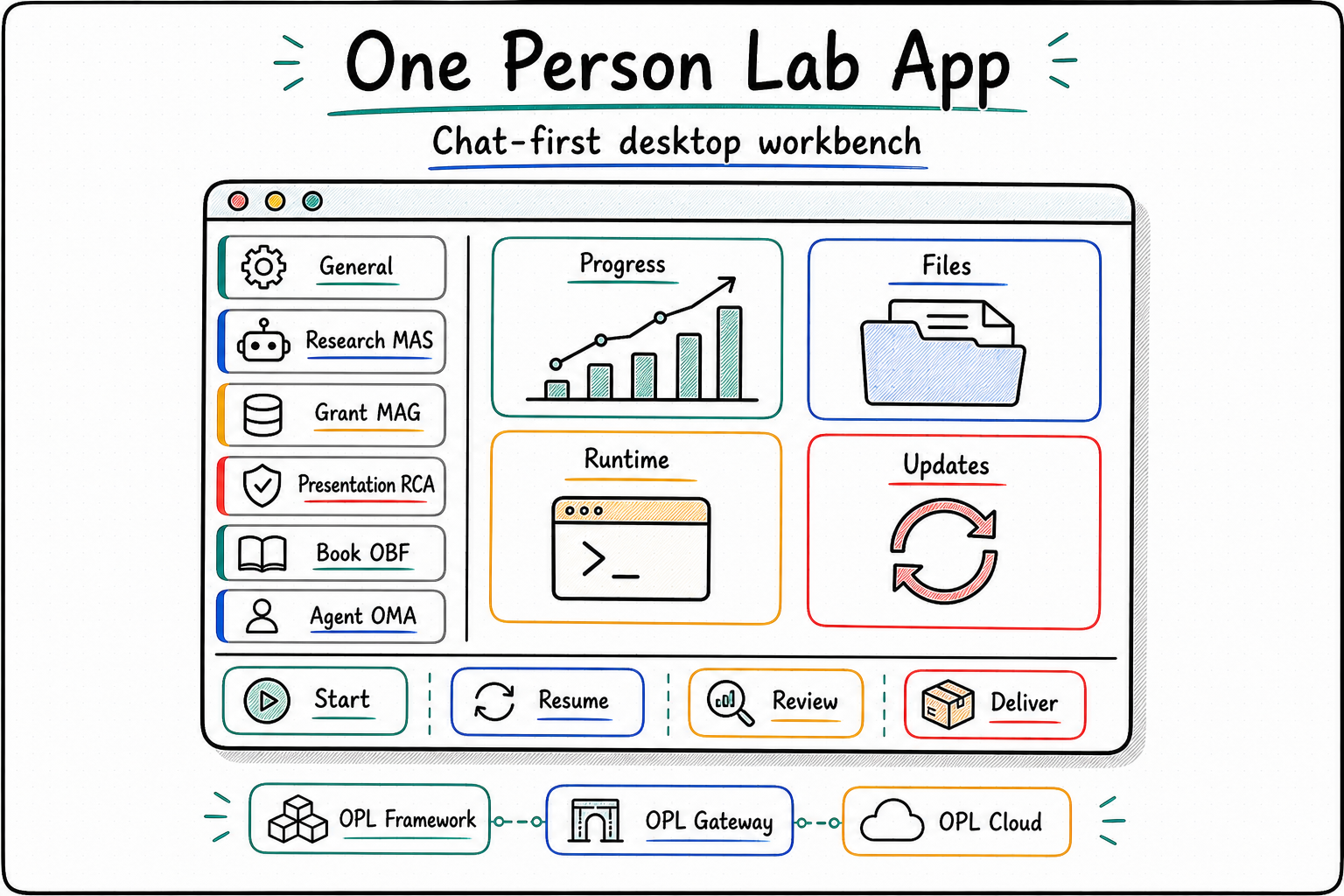
One Person Lab App is the lab’s published workbench for serious, long-running knowledge work. It gives users one place to start or continue Codex conversations, bring in project materials when needed, enter professional tasks exposed by installed Agent Packages, follow progress, review evidence, and collect deliverables such as manuscripts, proposals, slide decks, books, reviews, and project files.
The current macOS Stable implementation uses OPL Studio, built on DSH/Cordis, with native Codex conversations and Framework-owned runtime and Package state. The product remains One Person Lab App. A project directory is optional for ordinary conversations; installed Packages determine which specialist entry points are available. The App repository maintains the current platform and release details.
The technology is built around two reinforcing advantages.
1. A foundation for high-value knowledge delivery
OPL organizes open-ended expert judgment into visible stages with real artifacts, evidence, review, recovery, and clear human decisions. The shared Framework provides the reliable runtime and delivery model; the App makes that work legible and actionable; each Foundry Agent retains the standards and judgment of its domain.
MAS, MAG, RCA, and OBF apply this foundation to research, grants, visual communication, and long-form publishing. Med Auto Cast (MAC) extends the specialist portfolio into evidence-based medical explainer videos, with its own audiovisual and medical review requirements.
2. A meta-agent and self-evolving agent foundry
OPL Meta Agent (OMA) is the agent that develops agents. It turns a create, takeover, or improvement objective into a reviewable Agent blueprint, evaluation specification, and evidence-bound evolution proposal. The OPL Foundry Kernel then materializes candidates, runs evaluations, versions accepted results, and controls activation or rollback.
This separation of design judgment from controlled evaluation creates a compounding platform: evidence from existing agents can improve the next design, while reusable infrastructure lowers the time and marginal cost of creating each new specialist.
Specialist agents and installable capabilities
The lab’s public agent portfolio includes the following systems. The App discovers compatible installed Agent Packages dynamically; this portfolio does not imply that every agent is bundled with each App installation.
| Agent | Role | What it delivers |
|---|---|---|
| OPL Meta Agent (OMA) | Meta-agent and Agent Foundry | Designs, takes over, diagnoses, and evolves other OPL-compatible agents. |
| Med Auto Science (MAS) | Research agent | Evidence organization, analysis, manuscript preparation, review, and auditable study progression. |
| Med Auto Grant (MAG) | Grant agent | Grant direction setting, proposal development, simulated review, and revision. |
| RedCube AI (RCA) | Visual-deliverable agent | Presentations, reports, defenses, narrative design, rendering, review, and export. |
| OPL Book Forge (OBF) | Book agent | Planning, drafting, reviewing, and delivering books and long-form manuscripts. |
| Med Auto Cast (MAC) | Medical video agent | Medical evidence, storyboards, narration, animation, audiovisual review, and reusable media assets. |
Browse AI Systems & Open Software for the connected platform, domain agents, and shared capabilities. Each agent’s repository records its current implementation and validation scope.
Whitepapers
These five public whitepapers form the OPL family’s public design narrative: the family vision, Framework foundation, App workbench, Cloud product, and a concrete domain-agent practice.
| Whitepaper | Focus | Read online |
|---|---|---|
| One Person Lab Whitepaper | Why complex knowledge work needs expert stages, evidence, review, and recoverable delivery. | HTML |
| OPL Framework Whitepaper | How the Cordis Host turns the shared foundation into a composable, inspectable, and evolvable runtime. | HTML |
| OPL App Whitepaper | How the local-first workbench turns goals, materials, progress, artifacts, and decisions into one continuous user experience. | HTML |
| OPL Cloud Whitepaper | How the OPL work line extends to online workspaces, governed resources, collaboration, and Agent services. | HTML |
| MAS Agent Whitepaper | How the OPL model is applied to real medical-research work and publication-oriented delivery. | HTML |
Install One Person Lab App
Use the current Latest Stable release rather than a historical release or version-pinned asset. The maintained guides follow the current release channel:
- macOS first-install guide
- Windows x64 install and configuration guide
- Docker/WebUI install guide
- Linux x64 Desktop packages and the release-hosted universal installer are available from the Latest Stable release.
OPL Flow and OPL Fleet
OPL Flow is the Codex experience baseline and durable work-coordination layer. It keeps ownership, recovery, repository integration, and verifiable closeout coherent when work spans multiple tasks, conversations, and repositories.
OPL Fleet extends that coordination across machines. It is an Agent-native distributed execution and continuity system for durable objectives, compatible workspaces, fresh node admission, protected capacity, task dispatch, checkpoints, and owner-safe continuation. It complements Codex, SSH, GitHub runners, HPC, cloud, and container systems rather than replacing their strongest execution primitives.
Flow and Fleet are already used in regular and power-user workflows where one person is coordinating several AI tasks or machines at once. They are not required for basic App use; users can adopt them when the scale and continuity of the work justify the additional control layer.